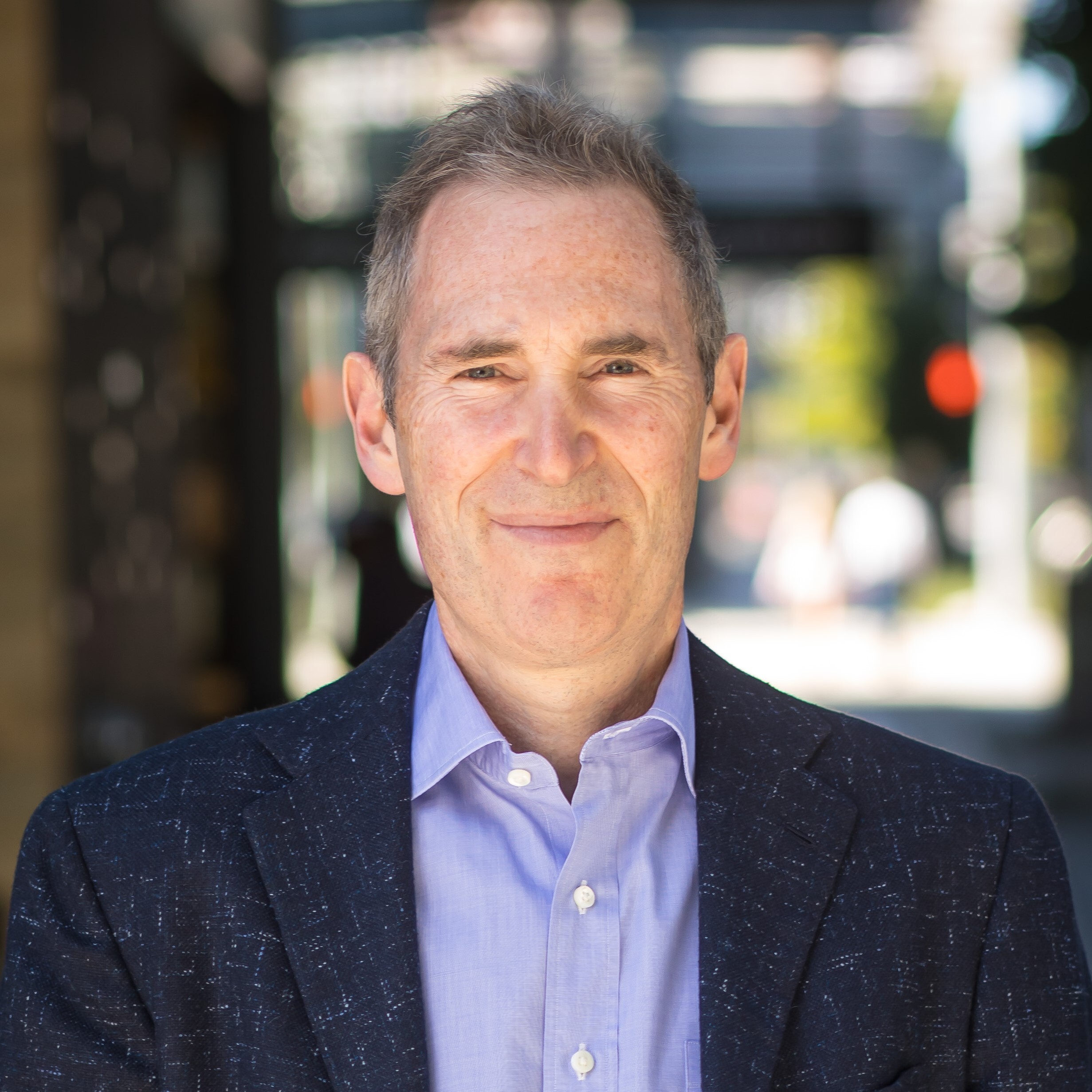
On the first episode of the fifth season of Fortune's Leadership Next podcast, co-host Alan Murray sat down with Amazon CEO Andy Jassy at Fortune's annual CEO dinner in Davos, published January 30, 2024. The conversation ranged across generative AI's investment calculus, the company's AI infrastructure strategy, leadership lessons from Jeff Bezos, healthcare, sustainability, and the FTC's antitrust case. The following is an edited transcript.
What do you see as the single biggest opportunity and the single biggest risk facing business in 2024?
I would say that the opportunity and risk is pretty similar, in that there is this wildly transformative, disruptive technology in generative AI that you can't get through any conversation without talking about. People were on this march pre-pandemic to modernize their technology. Then the pandemic happened. Then we had this economy where most enterprises tried to figure out how they could save money. A lot of the low-hanging fruit in cost optimization has attenuated over the last several months, and we're back to starting to invest. I just see companies really battling with the prioritization between continuing with the modernization of their technology platform or spending all their new engineering resources on generative AI.
In my opinion, you have to think about it in a balanced way. If you don't have your technology infrastructure foundation right, you are going to have a hard time being successful with generative AI. And it's such a sure win to modernize your technology and move to the cloud — it has a very predictable payback. And yet at the same time, I think you would be foolish not to figure out how to use generative AI successfully. A lot of companies will end up deciding to take the sure win of modernizing their technology platform and setting their foundation right, and then pick at least one or two generative AI initiatives where they can learn how to run it.
When people talk about generative AI, they mention OpenAI, Microsoft, Google, Meta — but not Amazon. Do you feel you've been behind?
I don't. Know who you're talking to, Alan. Not our customers. I think most of the conversation on generative AI so far has really been at the application layer — things like ChatGPT, which is by the way a really remarkable application. But the way that we think about AI is it has three layers of the stack, and all three are massive, and we're investing very heavily in all three.
At the bottom layer, if you're going to build your own large language models, you have to train them. The key to training is compute, and the key to compute is the chip. Today there's really been one GPU chip provider, and it's hard to get capacity. About five years ago we invested in building our own custom AI chips — Trainium for training and Inferentia for inference. We're on the second version, and they're going to be meaningfully more price-performant. The dirty little secret, if you have generative AI apps in production at scale, is that almost all the cost ends up being in the inference. People are going to really care about that price performance.
At the middle layer, for companies that don't want to build their own large language models, we built a service called Bedrock. It takes our own large language models, Anthropic's, Meta's Llama 2, Cohere, Stability AI — you can customize them with your own data without leaking it back into the general model. And what you learn when you actually build generative AI apps is that it's not going to be one model to rule the world. It's going to be lots of different models better at different things. And then at the top layer are the applications — including our coding companion called Q, which we launched a while back.
“This is like three steps into a marathon, but our customers really like what we're building.”
How does Alexa fit into all of this?
Alexa, like a number of different areas inside our company, is one of the many businesses that is building a significant large language model. We're building a much more expansive large language model that is aimed to fulfill our broader vision, which has always been the vision for Alexa: to be the world's best personal assistant.
You've been in this job two and a half years. How would you say your leadership style is different from your predecessor?
Look, I grew up at Amazon. I've been here for 26-and-a-half years and done so many different jobs. I've been lucky enough to work closely with Jeff — I worked directly for Jeff for 20 years. So I feel like I learned from somebody who's arguably the most unusual business leader of our era.
Every era of business leadership is different. When I started the job, nobody really predicted the pandemic would last that long, and Omicron would come, and the war in Ukraine would come, and the inflation. There are lots of things that happened throughout, and you have to just keep adjusting. We have a set of 16 leadership principles that we carefully crafted and recrafted over the years. I think the leadership principles are quite consistent. I think the leaders are very consistent culturally. It's just that we have some different folks leading the businesses at this point.
“I feel like I learned from somebody who's arguably the most unusual business leader of our era.”
What about power consumption? Generative AI is incredibly power-hungry — how do you square that with Amazon's Climate Pledge?
A lot of municipalities around the world underestimated how much power was required. Several of them told us they just took our estimates and cut them by a third — they just didn't believe them. And that was during the pandemic, before generative AI. Generative AI and these large language models are so power-hungry that it's been an explosion in demand, and there's not enough energy right now. We're going to have the dual challenge as a group to find a lot more energy to satisfy what people want to do with generative AI — but we've got to do it in a renewable way. It can't be going back to coal. For our part, we're already well over 90% renewable energy now, and we'll be 100% in 2025.
What's the next big thing to come from Amazon? Is it health care?
I think my kids' kids will not believe what the health care experience was for us. The fact that if you want to go see a doctor, you've got to make an appointment three or four weeks out, drive 20 minutes and park, wait in the waiting room, then wait in the exam room, and the doctor sees you for 10 minutes. That experience is just nutty. That will completely go away.
One Medical is a different way of doing primary care. It has an amazing digital interface. You can chat with doctors, do video conferences, make appointments same day or next day. All the reservations are integrated. And if you have pharmaceutical needs, they're connected to Amazon Pharmacy — you get what you need sent to your house within a day. We're really trying to get at changing the core health care experience, starting in the U.S., which I think has not been a happy place for a lot of people.
I'm also very bullish on Prime Video and what we're doing there — the combination of the customer experience, the content we build ourselves, the sports we have, and all our third-party media partners. And then there's Kuiper, our Earth-orbit satellite that will have a real meaningful impact on the 400 to 500 million households around the world that still don't have broadband connectivity — particularly in rural areas.
Amazon has this massive FTC antitrust case against it. Anything to that?
I am aware of it. I think they're wrong on the facts and the law. I think that will be borne out over time. More broadly, we need to be careful in Western countries not to kill innovation. If we only have strong regulations in Western countries, you'll leave the playing field open in other spots you don't mean to.